

You take a look at your section on a bright October afternoon, and light seems to be everywhere. But come back on a still day next June, and you realise that the same ground may sit in the shadow of the hill behind it. Not really what you have in mind, especially if you want a bright and warm home, ready to welcome the kids once they arrive from school.
That kind of gap between a spring viewing and a winter reality is where orientation errors begin. Sure, a heat pump can warm a cold room, but no heater can bring in the winter sun. The best house orientation NZ homeowners can look forward to is something that has been carefully thought of from the start.
Quick Summary
For New Zealand homes, the best or ideal house orientation puts your main living areas and largest windows facing north. More specifically, anywhere from 20° west to 30° east of true north. Bedrooms are best placed facing east, while service rooms such as the bathroom and the garage can take the colder south side. This is especially important, given Dunedin’s latitude. Its midday sun is located about 20° above the horizon in late June and is easily blocked by a hill or a neighbour’s roof.
A build on a south-facing section in Otago may still work, but it needs a design that will deliberately consider pulling in north light through careful planning of its windows and room placements. As a rule of thumb, it’s always best to check where the winter sun lands before you finalise any plans.
Which Way Should My House Face on an Otago Section?
House orientation in New Zealand comes down to one rule: your daytime living rooms and main windows should face north. Because New Zealand sits in the Southern Hemisphere, the sun tracks across the northern sky, and that is where your winter warmth comes from. MBIE’s Smarter Homes guidance on house orientation puts the acceptable range at anywhere between 20° west and 30° east of true north.
BRANZ’s Level guide on positioning a house on the site notes that true north is the optimum for living-room glazing, and that 5 degrees either side makes little practical difference. It also notes that houses which don’t make the most of solar gain can need up to three times more purchased energy to stay comfortable..
For energy efficiency, that makes orientation the first decision to get right, ahead of insulation or heating. Consider each orientation, and the rooms that suit them.
| Direction | What the sun does | Rooms that usually suit it |
|---|---|---|
| North | Sun for most of the day; low and deep in winter, high in summer | Living, dining, kitchen, main outdoor area |
| East | Morning sun, cooler by evening | Bedrooms, breakfast nook |
| West | Low afternoon sun, glare and summer heat | Evening rooms, with shading |
| South | Little direct sun, even daylight | Bathroom, laundry, garage, storage |
If your best view is of the harbour to the south, you may want the living room to face it, even though that side gets almost no winter sun. In such cases, we still recommend keeping the main living area on the north. But have open, smaller, and framed windows towards your preferred view instead.
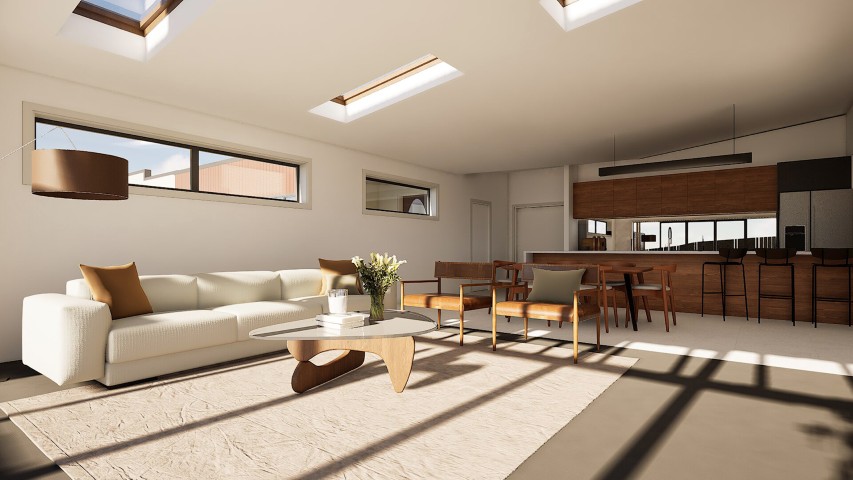
Summer and Winter Sun Angles in NZ: Why Dunedin Feels Them
The further south you build, the lower the winter sun sits, and Dunedin is close to the bottom of the country at roughly 45.9° south. A sun calendar for Dunedin shows the midday sun at only about 20° above the horizon in late June, against about 66° in mid-December. Daylight drops from 15 hours 47 minutes on the longest day to 8 hours 42 minutes on the shortest. In practice, that means three things:
- Winter sun reaches deep. At 20°, sunlight reaches far into north-facing living areas and warms the floor, which is free heat in July.
- Winter sun is easily blocked. A low sun casts long shadows, so a neighbour’s roof or a row of macrocarpa can block it for hours.
- Summer sun is easy to keep out. At 66°, eaves over north windows shade the glass. Large west windows are harder, because they take hot afternoon sun at a low angle.
Passive Solar Design in NZ Starts With the Plan
Passive solar design uses the building itself to collect the sun’s warmth. Orientation comes first. Then the north-facing windows are sized for winter gain, eaves are set for the summer sun, and a concrete floor (thermal mass) sits where the low sun can reach it. Insulation and double glazing keep that heat in through Dunedin’s long winter evenings.
Is a South-Facing Section in Otago a Bad Buy?
A south-facing section in Otago is not automatically a bad buy, but it asks more of the design, and it can affect value. Level reports a Motu study, Valuing Sunshine, which found that each extra hour of direct sun a house gets per day, averaged across the year, adds 2.4% to its market value. On a $700,000 house, that is roughly $16,800 for a single hour. A south-facing site can still borrow the sun:
- Put living rooms wherever north light can reach. On some sites, that is the back of the house rather than the street front.
- Bring sun in from above. MBIE notes that a clerestory window (a high window in a raised section of roof) can bring north sun into a south-facing home.
- Keep south glazing modest. Smaller, better-glazed windows frame the view while cutting heat loss.
- Check the shadows, not the compass. A south-facing section with open ground to the north can outperform a north-facing home that sits under a ridge.
Already own a house that faces the street rather than the sun? MBIE points out simple fixes, such as enlarging north windows or swapping room uses so the sunniest rooms become the living areas.

Understanding House Orientation NZ Designers Recommend
Epoch Architecture, as one of the leading architectural designers in Otago, checks the sun at Preliminary Investigation & Site Assessment. This is the second step of the studio’s nine-step design process, before any concept exists. That means confirming true north on the survey, checking what stands to the north, and mapping where the June shadows fall. MBIE advises thinking about orientation before you buy, and on Dunedin’s hill suburbs that advice carries extra weight.
If you have not bought yet, a site feasibility and property assessment shows how much winter sun a section really gets before you sign. If floor plans are hard to read, 3D visualisation and virtual walkthroughs show the sun moving through each room at any hour and season. The clients behind Radiant Abode saw their house in every season and at different times of day before it was built.
For a house that is not optimised for sunlight, we recommend that renovations and extensions often by moving the living area to the north side or extending toward the light. If you’re leaning toward a pre-designed plan, Your Way Home also follows the same principles, and the same check applies.
Frequently Asked Questions About House Orientation
What is the best direction for a house to face in NZ?
In New Zealand, north is the best direction for a home’s main living areas and windows. MBIE accepts anything from 20° west to 30° east of true north. A slight lean east picks up morning warmth; a lean west holds afternoon sun longer but needs more summer shading.
What is a north-facing house?
A north-facing house is one where the main living areas and the largest windows face north, not necessarily the front door. A house can have its entrance on the south side and still face north at the back. When a listing says “north-facing”, ask which rooms get the sun, and when.
Is a north-facing house good?
Yes, a north-facing home is usually the best option in New Zealand, because it gets winter sun through the middle of the day. It does have downsides. North glass without eaves can overheat in summer. If north is also the street side, you may need screening for privacy. A strong lean to the west adds afternoon glare as well.
Which direction is not good for a house to face?
South is the least helpful direction for living areas in Otago, because south-facing rooms get little direct sun and are harder to heat. West-facing houses are the other ones to watch, since their main windows overheat on summer afternoons. Both directions are fine for bathrooms and garages, which don’t need the sun.
How do I know which direction my house faces?
Check your main living-room window against true north. In Dunedin, a phone compass points about 26° east of true north, using GNS Science’s recommended models. Picture a clock: if your compass says north is at 12, true north sits close to 11, so cross-check your reading against a council property map, which shows true north. You can also note where the sun sits around solar noon, when it is due north in New Zealand.
Get the Sun Right Before You Commit
Sunlight is the one thing you cannot add later. Dunedin sits far enough south that a section which feels bright in February can be in shadow by June. The difference turns up in your power bill and in whether you use the room at all.
Epoch Architecture looks at your section’s slope, shelter, and orientation in relation to the sun before drawing anything. If you have a section you are about to build on, or a house that never seems to warm up, come in for a free first conversation at 31e Stafford Street. Call (03) 455 1505.
References
BRANZ. (2025, August 29). Positioning a house on the site. Level. https://www.level.org.nz/site-use/positioning-a-house-on-the-site/
Fleming, D., Grimes, A., Lebreton, L., Maré, D. C., & Nunns, P. (2017). Valuing sunshine: Executive summary. Motu Economic and Public Policy Research. https://motu.nz/assets/Documents/our-work/urban-and-regional/housing/Valuing-Sunshine-Executive-Summary.pdf
GNS Science. (n.d.). Earth’s magnetic field. Earth Sciences New Zealand. https://www.gns.cri.nz/our-science/land-and-marine-geoscience/geology-of-new-zealand/earths-magnetic-field/
Ministry of Business, Innovation and Employment. (2023, August 9). House orientation. Building Performance. https://www.building.govt.nz/getting-started/smarter-homes-guides/siting-and-location/house-orientation

